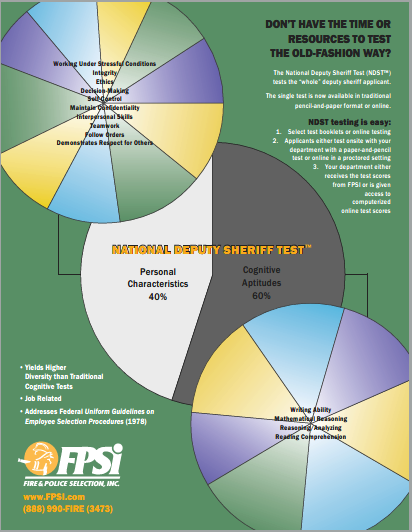
FPSI’s Online Testing Services bring the convenience and efficiency of a virtual platform to three of our most trusted entry-level law enforcement assessments: the Police Aptitude and Character Test (PACT), the National Deputy Sheriff Test (NDST), and the Structured Interview Package (SIP). Each of these tools has been carefully developed and validated to measure the critical cognitive, interpersonal, and decision-making skills candidates must demonstrate from the very first day on the job.
Administering these assessments online allows agencies to reach a broader pool of applicants, reduce scheduling and facility requirements, and significantly lower the time and costs associated with traditional in-person test administration. For candidates, online delivery offers greater accessibility and convenience, making it easier to participate in the process while still ensuring a fair, secure, and content-valid evaluation.
With FPSI’s online testing options, departments can streamline recruitment while maintaining the validity, reliability, and defensibility of their selection process.
Would you like to preview one of our Online Law Enforcement Tests and receive more information on the testing process?
Departments may preview the PACT or the NDST before purchasing. Click here to order your sample today!
FPSI addresses the federal Uniform Guidelines On Employee Selection Procedures.